A mote of dust
I've been reading a lot about Carl Sagan lately. The algorithm noticed, so now my feeds are full of his work. I'm currently going through The Demon-Haunted World: Science as a Candle in the Dark.
There's a quote from the book that keeps coming back to me:
"We've arranged a global civilization in which most crucial elements—transportation, communications, and all other industries; agriculture, medicine, education, entertainment, protecting the environment; and even the key democratic institution of voting—profoundly depend on science and technology. We have also arranged things so that almost no one understands science and technology. This is a prescription for disaster. We might get away with it for a while, but sooner or later this combustible mixture of ignorance and power is going to blow up in our faces."
This is what we're living through right now. Climate collapse, AI being used to replace people instead of support them, misinformation everywhere. The world order feels like it's shifting. Away from dialogue, towards force. Away from rules, towards raw power. It feels like the whole world is moving away from light and straight into darkness.
I talked about all this with Janet, an old lady who owns the building where I work. She was born in Britain during World War II, moved to Canada when she was young, and has seen a lot. When I told her how bleak everything feels, she said something simple: young people like me have to keep faith that things will get better.
And I think she's right. We have to believe that. We can still build something better if we choose to.
Here's what gets me: we might be the only place in the entire galaxy with life that can think, observe, understand. And we're killing ourselves over stupid shit. That should matter to all of us.
Sagan put it better than I ever could in Pale Blue Dot:
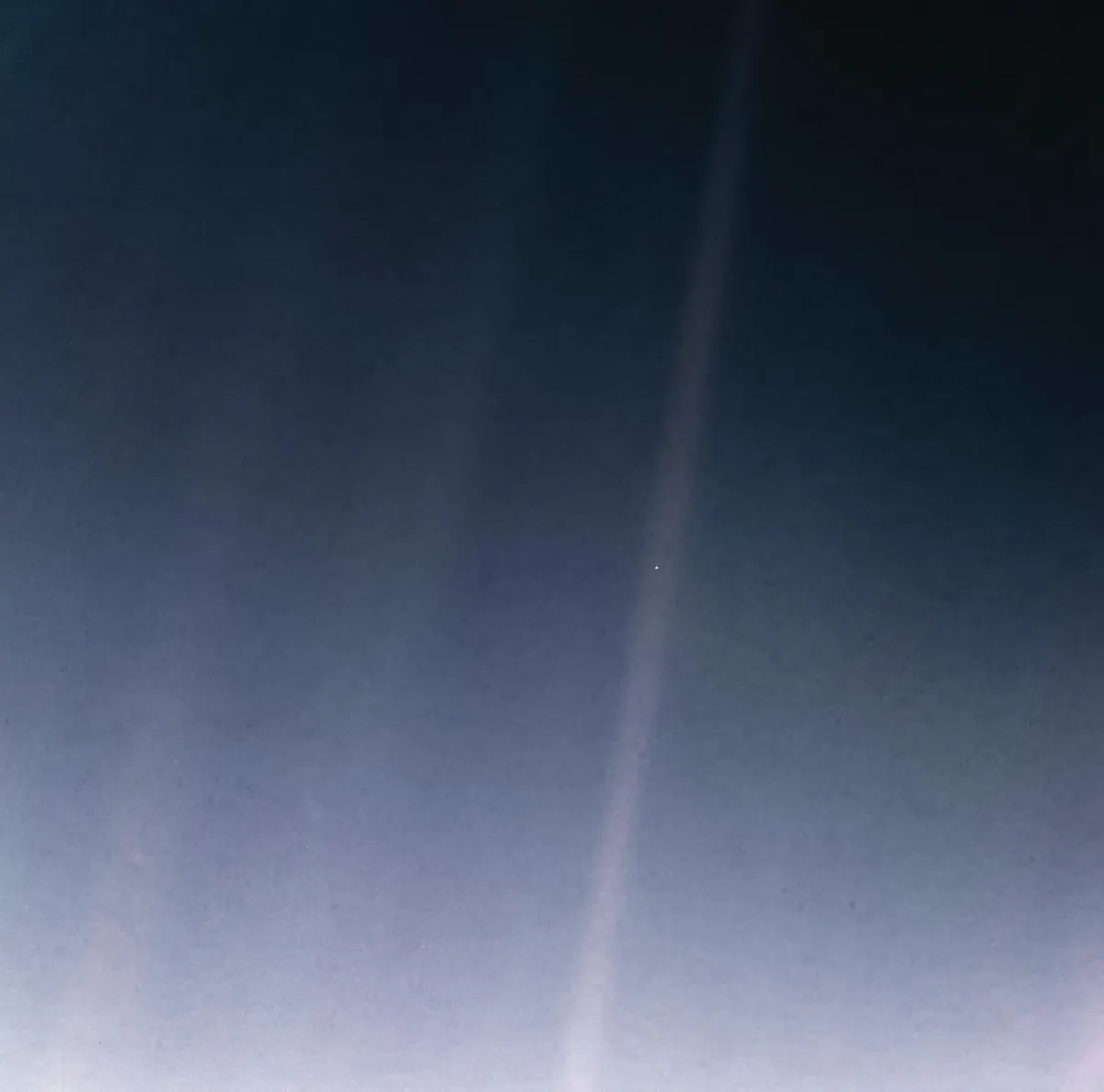
"Look again at that dot. That's here. That's home. That's us. On it everyone you love, everyone you know, everyone you ever heard of, every human being who ever was, lived out their lives. The aggregate of our joy and suffering, thousands of confident religions, ideologies, and economic doctrines, every hunter and forager, every hero and coward, every creator and destroyer of civilization, every king and peasant, every young couple in love, every mother and father, hopeful child, inventor and explorer, every teacher of morals, every corrupt politician, every 'superstar,' every 'supreme leader,' every saint and sinner in the history of our species lived there—on a mote of dust suspended in a sunbeam.
The Earth is a very small stage in a vast cosmic arena. Think of the endless cruelties visited by the inhabitants of one corner of this pixel on the scarcely distinguishable inhabitants of some other corner, how frequent their misunderstandings, how eager they are to kill one another, how fervent their hatreds.
Our planet is a lonely speck in the great enveloping cosmic dark. In our obscurity, in all this vastness, there is no hint that help will come from elsewhere to save us from ourselves. The Earth is the only world known so far to harbour life. There is nowhere else, at least in the near future, to which our species could migrate. Visit, yes. Settle, not yet. Like it or not, for the moment the Earth is where we make our stand.
It has been said that astronomy is a humbling and character-building experience. There is perhaps no better demonstration of the folly of human conceits than this distant image of our tiny world. To me, it underscores our responsibility to deal more kindly with one another, and to preserve and cherish the pale blue dot, the only home we've ever known."
We have a responsibility. We're here, and maybe we're all there is.
From the rooftop,
੯‧̀͡⬮ João Siqueira